
Diana Barnato Walker
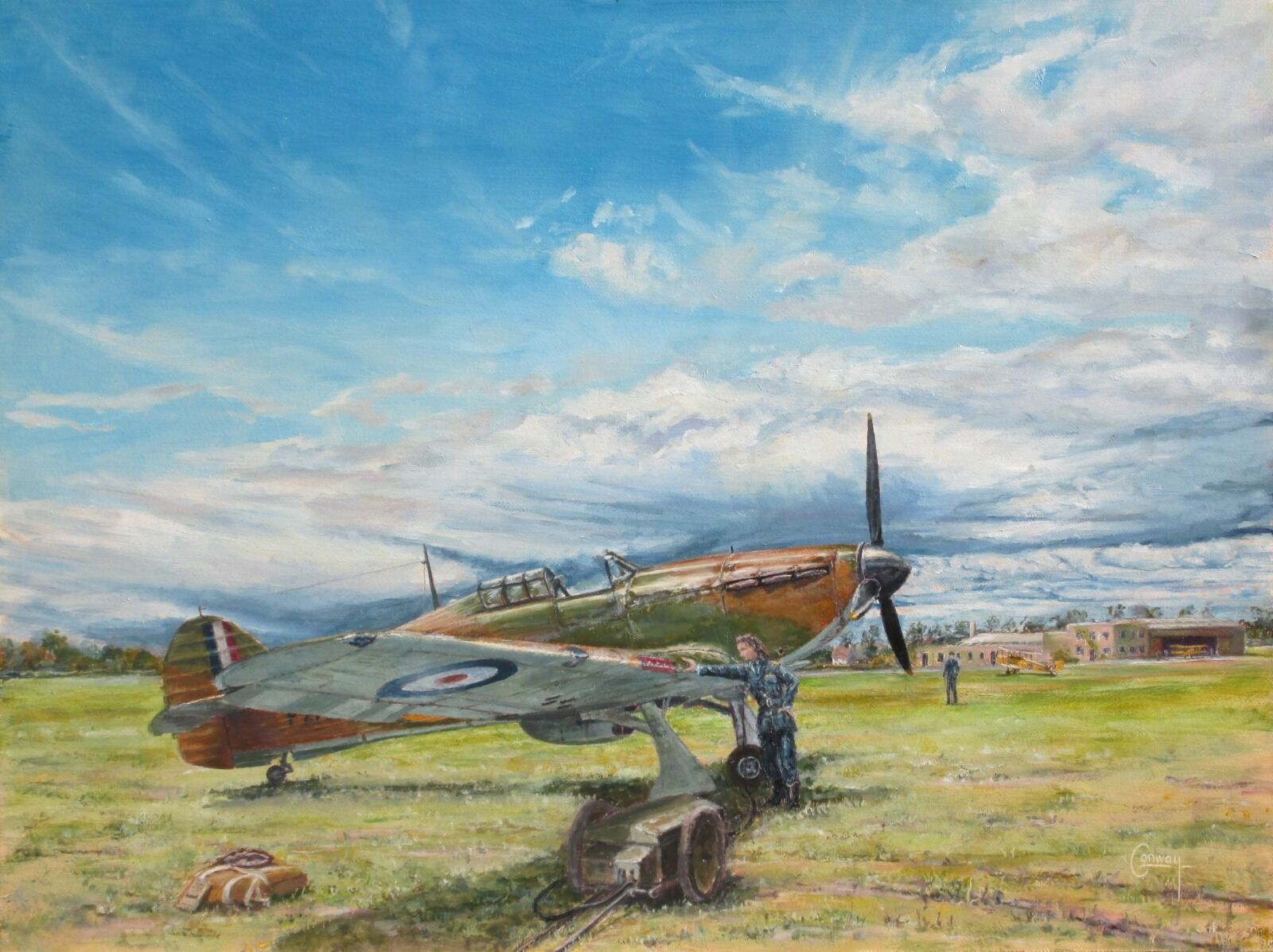
I think I’m going to struggle a little to part with this painting… To be honest I get quite attached to a lot of them, but there was something different about the experience of painting this one..
There is as always a story, of course, but here the creation of the piece kind of became a story unto itself. It was a story that evolved from a simple concept, and a story of a remarkable woman, whose tale I learned with ever growing respect and wonder over the couple of weeks it took to paint this piece…
Let me rewind to the starting point though… Last spring a delightful individual from West London Aero Club , whose flying adventures I follow on Instagram, messaged me to ask me if I’d like to have a stand at their Member’s Day at White Waltham Aerodrome in Berkshire.
I’d never done such a thing before, but the delightful invitation; the pleasant, welcoming look of the club; and the friendly nature of the event made me think that this was something that I really should do.
What was more was the location… not only is it the home of the current flying operations of Hurricane Heritage, but the name of the aerodrome is one that resonates deeply for any WW2 aviation enthusiast. White Waltham was the home of that remarkable wartime organisation the Air Transport Auxiliary, probably better known to most by its initials, the ‘ATA’.
The story of the ATA easily justifies a whole article unto itself, but to avoid risk of a massive digression I shall confine myself to a brief summary of it here:
Set up at the beginning of the war, the organisation used civilian pilots to take on the duties of transporting/ferrying the military aircraft needed by the RAF to where they needed to be, with the aim of freeing up front line RAF pilots to focus on their core duties of continuing the fight.
The organisation was immensely successful: In the course of the war from its foundation in 1939 to its disbandment in late 1945, its 1,250 aircrew carried out a staggering 309 thousand ferry flights. Almost from the outset, the organisation also had the foresight to recruit female as well as male pilots and the ATA included 166 female aircrew.
One of the remarkable things about the pilots of the ATA that has always struck me, was that once trained and passed on a generic type (eg. single engine fighters or twin engined aircraft), the pilots were expected to fly almost any type of aircraft in that category. What’s more they were expected to be able to do this with no more training than perhaps a brief walk through the controls and a study of the pilots notes immediately prior to flying. It is easy to see how the organisation gained, and earned in no small measure, the delightful nickname based on its official initials, ATA… ‘Anything to Anywhere’.
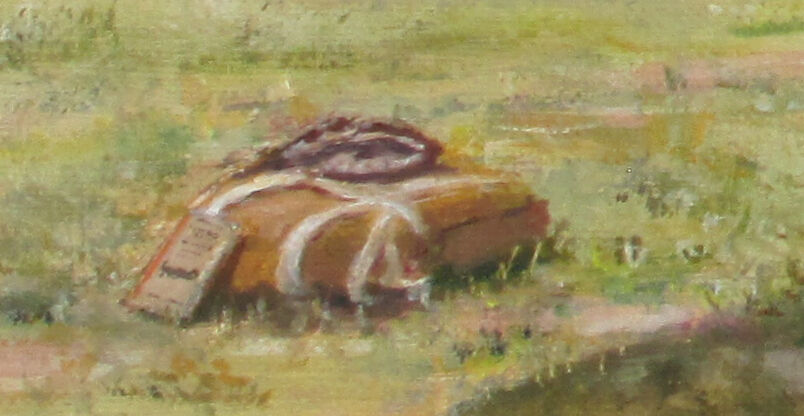 I included Diana's pilot's notes for the Hurricane in the painting, in recognition of the ATA pilot's ability to fly a new type of aircraft with barely more than a study of these precious notes.
In the end, the invitation to participate in the Aerodrome’s Member’s Day proved irresistible for me, and sparked off a flurry of activity here, working out just how to get everything together for our first art ‘stand’, with our own marquee, at an airshow.
There was something more to all this though… I had never visited White Waltham before, and to be there, at the home of the ATA, with my aviation paintings felt like something really special. Being an artist, it is unsurprising that I wanted to mark the occasion with a painting - one that captured something of the meaning of it all to me.
I knew it was going to be an ATA painting, and I somehow figured that featuring one of my favourite aircraft, the Hurricane, in it, seemed like it would be right too: With Hurricane Heritage’s current presence there, flying two Hurricanes from the airfield, one of them the only flying Battle of Britain veteran Hurricane left, just tied in so perfectly with my art.
A painting like this doesn’t just ‘happen’ though… What followed was a another dive down so many wormholes of research.. I found images of the aerodrome from just before the war, and found out about how the aerodrome had also changed through the years since, to become what it is today. Although it has changed geographically a little, it still retains the same all grass airstrip that was so familiar to the ATA pilots all those years ago. (And rather delightfully many noted that the warm ‘spirit’ of the place fostered by the ATA has changed hardly at all over those years too.)
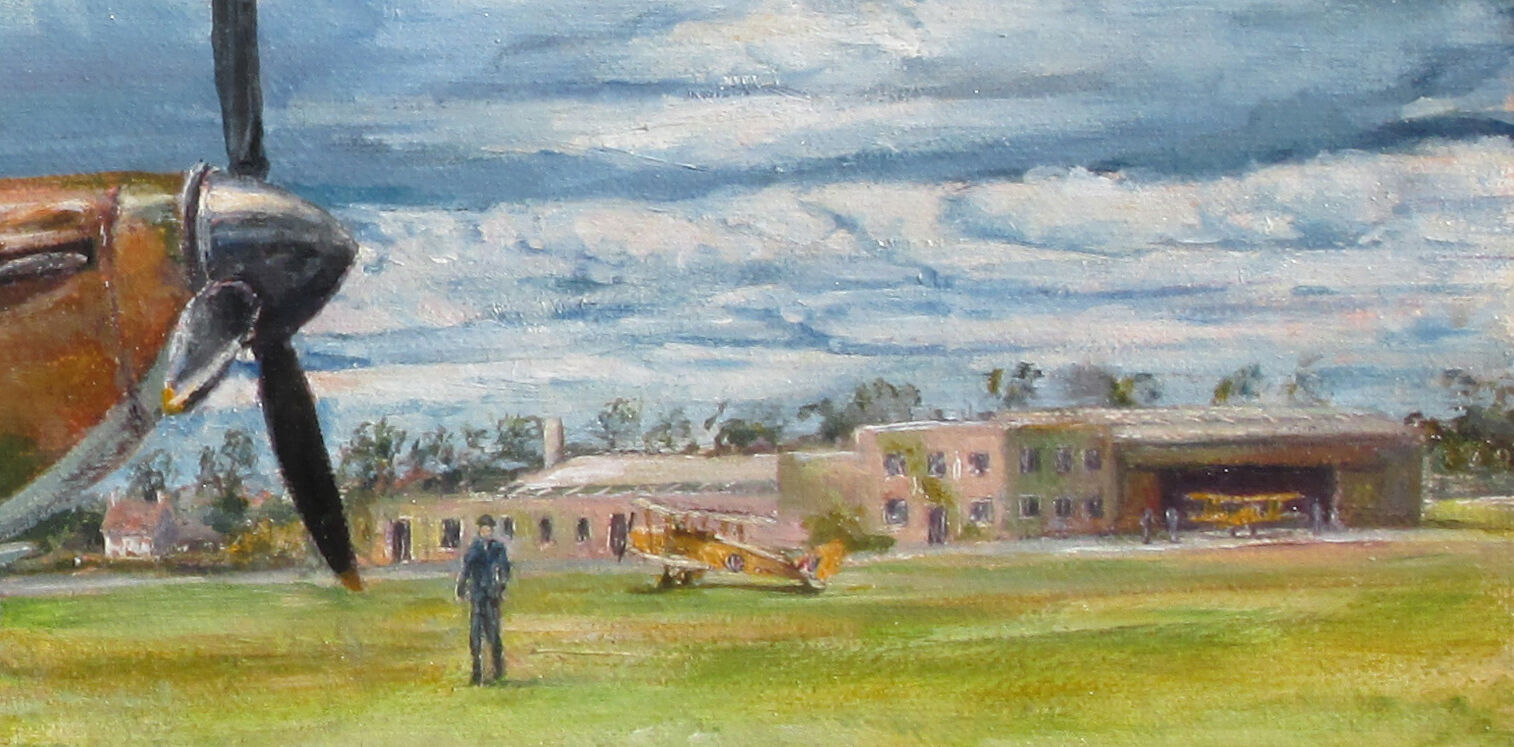 The delightful pre-war buildings at White Waltham featured in the background of my painting (painted with camouflage at the outset of the war!)
That still left me a vacuum though… I wanted to link the Hurricane into the piece in a specific real moment; one connected with one of these brave members of the ATA during the war. Fortunately, the discovery of the wonderful digitised archives of the ATA Museum at Maidenhead Heritage Centre provided not only a period of fascinating absorption, but led me to where I needed to be…
Leafing on line through the scanned in images of her original logbook, I discovered that ATA pilot, Diana Barnato Walker, had made her first flight in a Hurricane on August 26th 1942, almost exactly the same date that I was due to be at the airfield some 83 years later… it seemed just a perfect subject for a painting which carried just the meaning I was after.
I have to confess at this point that although having heard of Diana Barnato Walker as an ATA pilot (henceforth ‘DBW’, to use her own moniker for herself), and knowing of her post war flight that led her to become the first British woman to break the sound barrier, I knew little else about her. It was an omission that I felt bound to rectify as soon as possible.
Thus, in amongst my continued research on the airfield for the painting, an order for a second hand copy of her autobiography, ‘Spreading my Wings’, was made, and patiently waited for in the post, whilst I began to work out the idea for the painting in pencil sketches.
Before the book arrived, I had more or less established the composition for the painting, but held off shifting the idea to the canvas. I wanted to check whether there was any personal recollection of hers in the book, of the moment of her first flight in the Hurricane, and particularly whether her memory of the event seemed to accord with how my imagination had already visualised it on paper.
It seemed quite some wait, as I felt eager to push on with the painting, and the timescale for its completion was fast approaching if it was to be done before both the airshow day, and the anniversary it now seemed intended to commemorate.
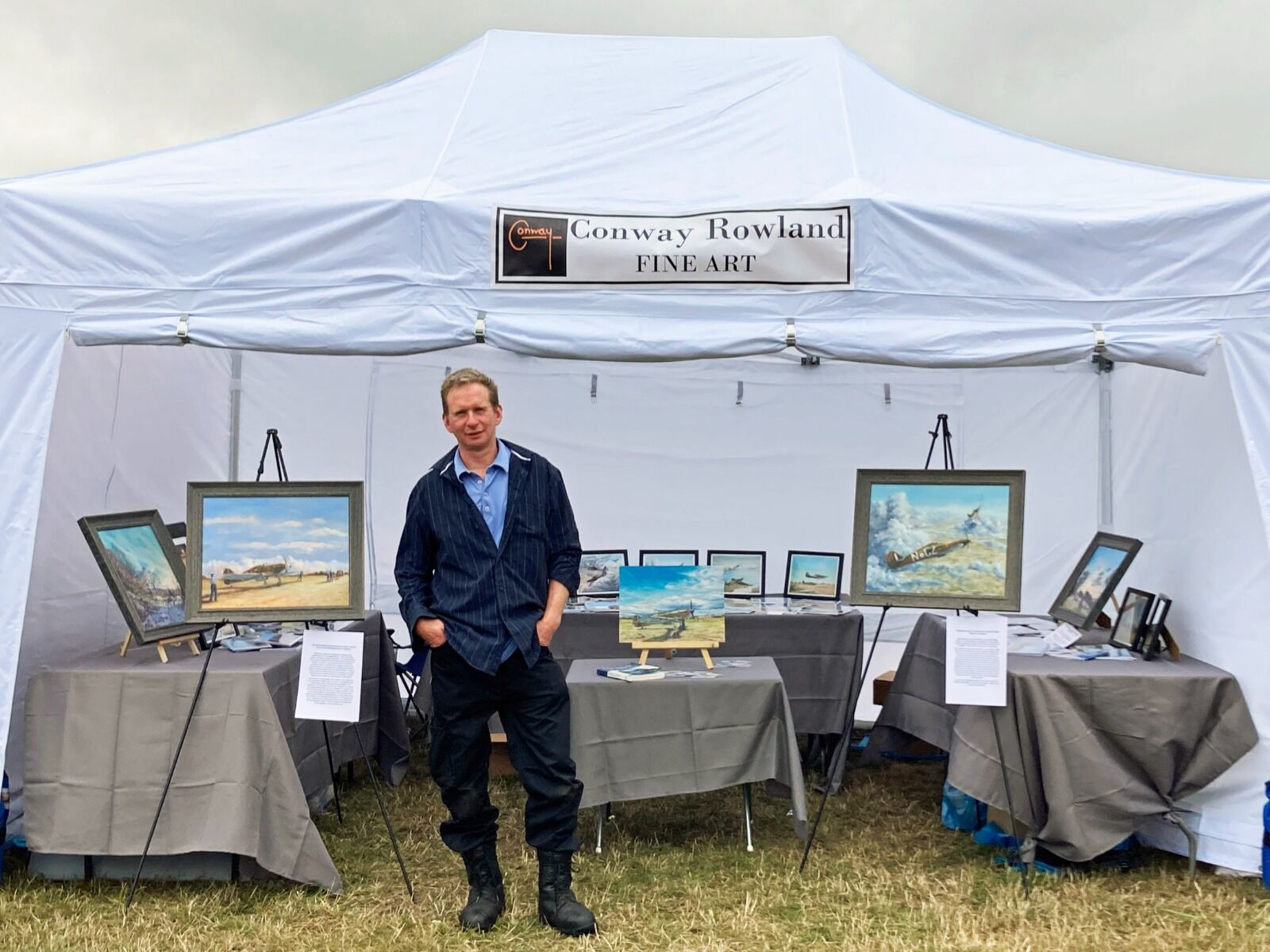 I did get the painting done in time to mark the special date, and here it is on my stand with Diana's biography alongside at the airshow, in pride of place, with it's own table in the centre of my stand.
It will come as no surprise that when the book arrived, I pounced upon it, to find if this moment was there. It was a delightful page or so that covered that day, her first experience of flying the Hurricane; it was clearly a big moment for her as her first single engine fighter aircraft. I was relieved too, to read that there felt to be nothing that clashed with the scene as I had drawn it, so the ‘chocks were away’ on the painting, and I fell to starting it that day.
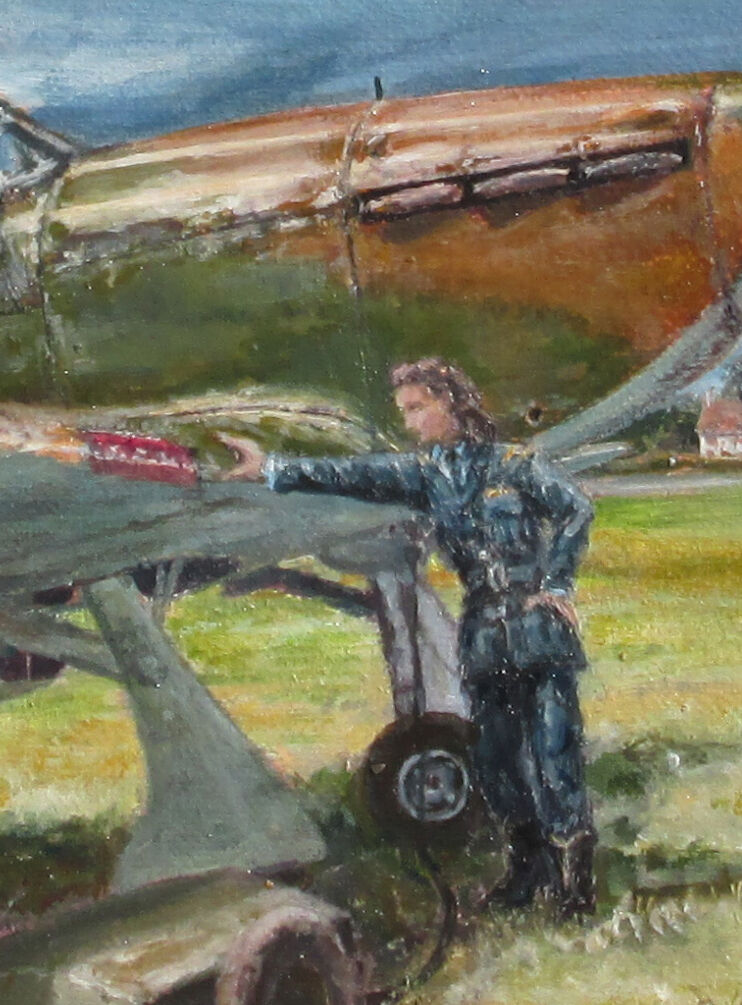
The painting in itself was a joy to create. That marvellous silhouette of the Hurricane against a wild summer sky, the attractive pre-war aerodrome buildings in the background with a couple of tiny Tiger Moths scattered in the distance. And of course, the figure of Diana herself, earnestly engaged in her pre-flight walkaround of the aircraft, with parachute, helmet and a tiny copy of her pilot’s notes for the Hurricane propped against them. I could almost hear the panels of the airframe creaking a little as the sun warmed them and the restrained but palpable sense of anticipation for the moments to come. Moments lay ahead where this slightly tired, but carefully maintained, and still majestic, Hurricane would spring once again to life and trundle across the grass with this amazing young lady at the controls, one who had no idea of the quiet legend she was to become...
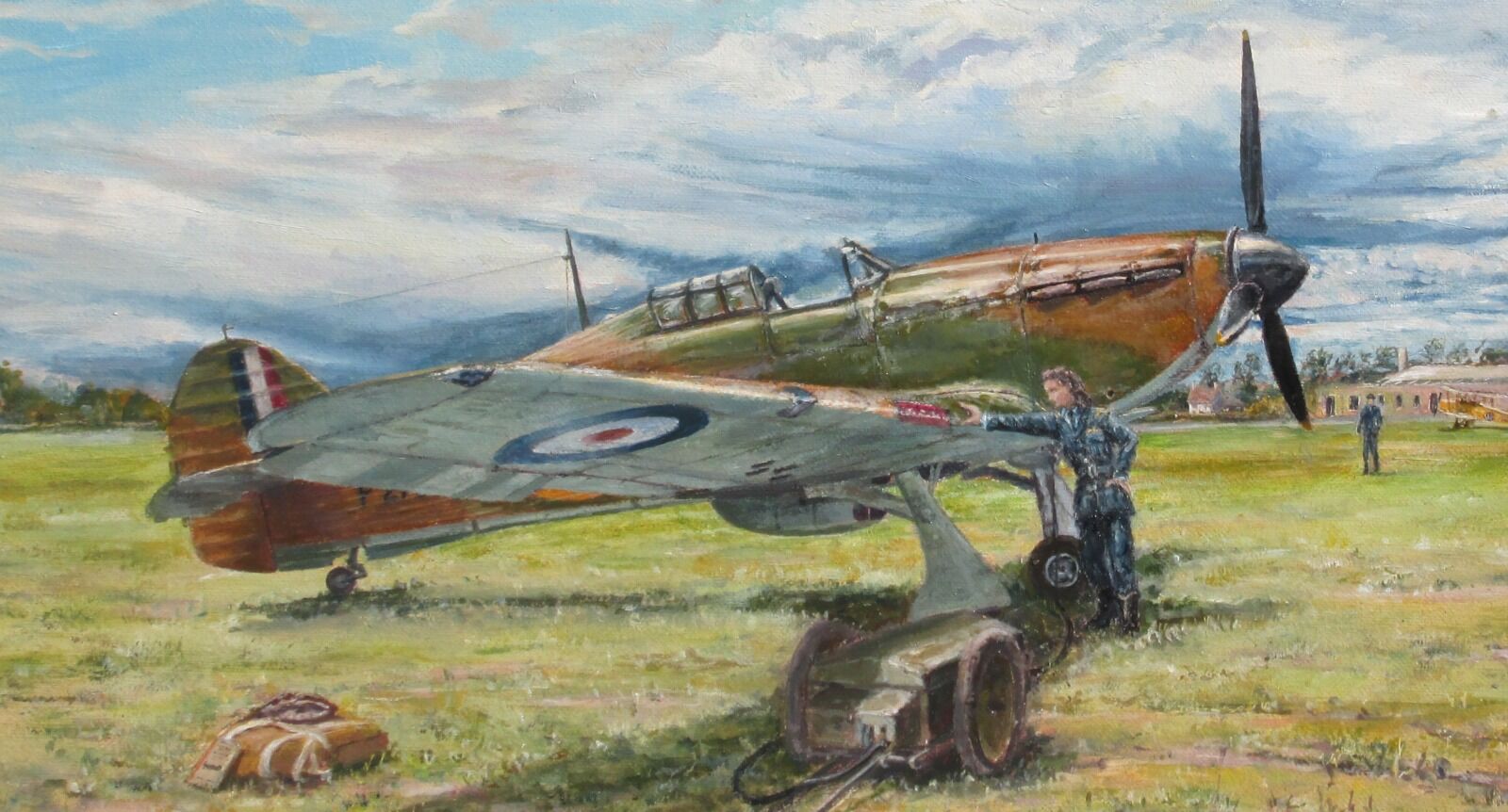 DBW does her walkaround of the Hurricane just prior to her first ever flight in a monoplane fighter. She would go on to deliver hundreds of Hurricanes and other fighters..
I think ‘quiet legend’ is the perfect way to put it too. For the real revelation for me wasn’t actually the painting, it was the experience of reading her autobiography. This happened in short snippets over lunch every day for the next couple of weeks, whilst just through the door the painting of the amazing character I was reading about slowly took shape.
Just the unembellished facts of her wartime achievements and life tell their own story. Joining up as a nurse with the Red Cross at the outset of the war, she served as a VAD nurse with the Red Cross in France and London during 1940. With typical modesty and humour, the only story she related in her biography from these days was the moment where the ambulance she was driving had broken down. Trying to resolve the situation, she volunteered to use her own Bentley Sports car (!) to ferry the resulting stranded group of pregnant women, only for the con rod on it to come flying out of the crankcase with the car going ‘far too fast’ (in her own words) along an empty bypass!
But for a young woman who had grown up as the daughter of Woolf Barnato, the Chairman of Bentley motors and leading light of the famous Bentley racing car team, it’s perhaps easy to see that serving as a nurse was never quite going to cut it for her. So brushing up on her brief previous training as a pilot, she applied to join the ATA in 1941. Over the course of the war, she was to deliver many hundreds of aircraft of so many different types.
She was also to experience the loss of her fiancé, Spitfire pilot, S/Ldr. Humphrey Gilbert, during the war, and then the further loss of her husband, another fighter pilot, W/Co. Derek Walker, immediately following the end of the war. Her resilience to these tragic experiences seems little short of remarkable, and one can only imagine the internal scars these losses must have left her over her life.
Yet her indomitable spirit seems to have never failed to eternally shine through. Not least in her efforts to inspire the next generation of female aviators and aviation engineers after the war providing experience flights and training with the Women’s Junior Air Corps. On one flight involved with this she demonstrated that innate skill and judgement once again, bringing an aircraft, which had caught fire due to an electrical fault shortly after take off, calmly back in to land.
She also seized the idea put to her by an RAF friend that she should fly the RAF’s supersonic Lightning fighter. With characteristic determination of purpose, she worked at getting all the right assents and approvals for this to happen through the official channels, and she thus became the first woman in the UK to break the sound barrier.
All this, and that’s not to mention raising her child, coping with illness, and even taking over the running of her mother’s sheep farm in Surrey in her later years.
Yet strangely, all these remarkable facts of her life weren’t what really stood out of the book for me. It was each little excerpt of another ‘ordinary’ day in her life as an ATA pilot that had me reeling. The book was filled with remarkable moments where her incredible skill and intuitive decision making in the air seemed to bring her home safe, time and again, against the odds (attributed by her though, with a typical self-effacing humour to having a ‘guardian angel’).
I also thrilled to her retelling of the stories of her fellow ATA pilots, which exuded all the quiet unspoken skill and professionalism of so many of the amazing pilots of the organisation. I was left astonished at what they dared to achieve with the staggering simplicity of the flying aids available to them. To cite just one example, there were not even activated radios in the aircraft they flew to call for a bearing to land should sudden low cloud conditions develop, which although they largely coped with, sadly cost the lives of several of their number.
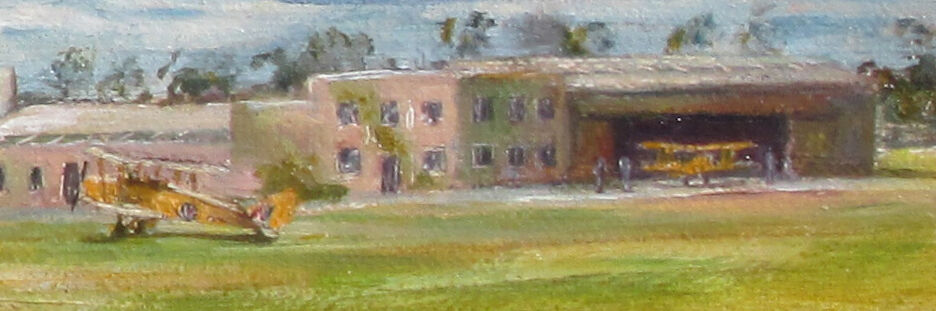 The Tiger Moth aircraft, in the background of this painting, were the basic training aircraft for both the RAF and the ATA. Unlike their RAF counterparts though, ATA pilots received no training on 'blind' flying (with instruments only), and had standing instructions to bale out of aircraft they were flying should the weather conditions mean they would have to attempt landing through cloud.
There was an exuberant joy exhibited in her relating of the funny side of things too. Her own ‘naughty’ first roll in a PR Spitfire (any aerobatics being strictly forbidden in the ATA), which resulted in an unexpected incident with her powder compact, was particularly amusing. Or there was the story of the flight she experienced with a fellow ATA pilot, timed only by cigarettes (!!). These are just two examples of many that exhibited her unfailing sense of humour throughout it all.
There was something quite unique in this experience of reading a little more of her story every day and then returning to the canvas to continue ‘her’ painting. Her writing was in itself already most engaging, and brought me into the moments she described so vividly. This meant that for me, the painting felt as alive and real as if I had been painting a portrait of someone standing in front of me in the same room, even though it was bridging a gap of over 85 years.
Her wonderful sense of humour and vibrant, energised, brave and resilient personality that so constantly shone out of the book seemed somehow infused into the art. Diana was one of the many at the time who found themselves emerging into their adulthood, confronted with a challenge of an almost inconceivable scale, and just got on with it all.
For me this piece is forever illuminated from within by her wonderful spirit, a spirit that exemplified of all that was best of this amazing generation.
There is as always a story, of course, but here the creation of the piece kind of became a story unto itself. It was a story that evolved from a simple concept, and a story of a remarkable woman, whose tale I learned with ever growing respect and wonder over the couple of weeks it took to paint this piece…
Let me rewind to the starting point though… Last spring a delightful individual from West London Aero Club , whose flying adventures I follow on Instagram, messaged me to ask me if I’d like to have a stand at their Member’s Day at White Waltham Aerodrome in Berkshire.
I’d never done such a thing before, but the delightful invitation; the pleasant, welcoming look of the club; and the friendly nature of the event made me think that this was something that I really should do.
What was more was the location… not only is it the home of the current flying operations of Hurricane Heritage, but the name of the aerodrome is one that resonates deeply for any WW2 aviation enthusiast. White Waltham was the home of that remarkable wartime organisation the Air Transport Auxiliary, probably better known to most by its initials, the ‘ATA’.
The story of the ATA easily justifies a whole article unto itself, but to avoid risk of a massive digression I shall confine myself to a brief summary of it here:
Set up at the beginning of the war, the organisation used civilian pilots to take on the duties of transporting/ferrying the military aircraft needed by the RAF to where they needed to be, with the aim of freeing up front line RAF pilots to focus on their core duties of continuing the fight.
The organisation was immensely successful: In the course of the war from its foundation in 1939 to its disbandment in late 1945, its 1,250 aircrew carried out a staggering 309 thousand ferry flights. Almost from the outset, the organisation also had the foresight to recruit female as well as male pilots and the ATA included 166 female aircrew.
One of the remarkable things about the pilots of the ATA that has always struck me, was that once trained and passed on a generic type (eg. single engine fighters or twin engined aircraft), the pilots were expected to fly almost any type of aircraft in that category. What’s more they were expected to be able to do this with no more training than perhaps a brief walk through the controls and a study of the pilots notes immediately prior to flying. It is easy to see how the organisation gained, and earned in no small measure, the delightful nickname based on its official initials, ATA… ‘Anything to Anywhere’.
In the end, the invitation to participate in the Aerodrome’s Member’s Day proved irresistible for me, and sparked off a flurry of activity here, working out just how to get everything together for our first art ‘stand’, with our own marquee, at an airshow.
There was something more to all this though… I had never visited White Waltham before, and to be there, at the home of the ATA, with my aviation paintings felt like something really special. Being an artist, it is unsurprising that I wanted to mark the occasion with a painting - one that captured something of the meaning of it all to me.
I knew it was going to be an ATA painting, and I somehow figured that featuring one of my favourite aircraft, the Hurricane, in it, seemed like it would be right too: With Hurricane Heritage’s current presence there, flying two Hurricanes from the airfield, one of them the only flying Battle of Britain veteran Hurricane left, just tied in so perfectly with my art.
A painting like this doesn’t just ‘happen’ though… What followed was a another dive down so many wormholes of research.. I found images of the aerodrome from just before the war, and found out about how the aerodrome had also changed through the years since, to become what it is today. Although it has changed geographically a little, it still retains the same all grass airstrip that was so familiar to the ATA pilots all those years ago. (And rather delightfully many noted that the warm ‘spirit’ of the place fostered by the ATA has changed hardly at all over those years too.)
That still left me a vacuum though… I wanted to link the Hurricane into the piece in a specific real moment; one connected with one of these brave members of the ATA during the war. Fortunately, the discovery of the wonderful digitised archives of the ATA Museum at Maidenhead Heritage Centre provided not only a period of fascinating absorption, but led me to where I needed to be…
Leafing on line through the scanned in images of her original logbook, I discovered that ATA pilot, Diana Barnato Walker, had made her first flight in a Hurricane on August 26th 1942, almost exactly the same date that I was due to be at the airfield some 83 years later… it seemed just a perfect subject for a painting which carried just the meaning I was after.
I have to confess at this point that although having heard of Diana Barnato Walker as an ATA pilot (henceforth ‘DBW’, to use her own moniker for herself), and knowing of her post war flight that led her to become the first British woman to break the sound barrier, I knew little else about her. It was an omission that I felt bound to rectify as soon as possible.
Thus, in amongst my continued research on the airfield for the painting, an order for a second hand copy of her autobiography, ‘Spreading my Wings’, was made, and patiently waited for in the post, whilst I began to work out the idea for the painting in pencil sketches.
Before the book arrived, I had more or less established the composition for the painting, but held off shifting the idea to the canvas. I wanted to check whether there was any personal recollection of hers in the book, of the moment of her first flight in the Hurricane, and particularly whether her memory of the event seemed to accord with how my imagination had already visualised it on paper.
It seemed quite some wait, as I felt eager to push on with the painting, and the timescale for its completion was fast approaching if it was to be done before both the airshow day, and the anniversary it now seemed intended to commemorate.
It will come as no surprise that when the book arrived, I pounced upon it, to find if this moment was there. It was a delightful page or so that covered that day, her first experience of flying the Hurricane; it was clearly a big moment for her as her first single engine fighter aircraft. I was relieved too, to read that there felt to be nothing that clashed with the scene as I had drawn it, so the ‘chocks were away’ on the painting, and I fell to starting it that day.
The painting in itself was a joy to create. That marvellous silhouette of the Hurricane against a wild summer sky, the attractive pre-war aerodrome buildings in the background with a couple of tiny Tiger Moths scattered in the distance. And of course, the figure of Diana herself, earnestly engaged in her pre-flight walkaround of the aircraft, with parachute, helmet and a tiny copy of her pilot’s notes for the Hurricane propped against them. I could almost hear the panels of the airframe creaking a little as the sun warmed them and the restrained but palpable sense of anticipation for the moments to come. Moments lay ahead where this slightly tired, but carefully maintained, and still majestic, Hurricane would spring once again to life and trundle across the grass with this amazing young lady at the controls, one who had no idea of the quiet legend she was to become...
I think ‘quiet legend’ is the perfect way to put it too. For the real revelation for me wasn’t actually the painting, it was the experience of reading her autobiography. This happened in short snippets over lunch every day for the next couple of weeks, whilst just through the door the painting of the amazing character I was reading about slowly took shape.
Just the unembellished facts of her wartime achievements and life tell their own story. Joining up as a nurse with the Red Cross at the outset of the war, she served as a VAD nurse with the Red Cross in France and London during 1940. With typical modesty and humour, the only story she related in her biography from these days was the moment where the ambulance she was driving had broken down. Trying to resolve the situation, she volunteered to use her own Bentley Sports car (!) to ferry the resulting stranded group of pregnant women, only for the con rod on it to come flying out of the crankcase with the car going ‘far too fast’ (in her own words) along an empty bypass!
But for a young woman who had grown up as the daughter of Woolf Barnato, the Chairman of Bentley motors and leading light of the famous Bentley racing car team, it’s perhaps easy to see that serving as a nurse was never quite going to cut it for her. So brushing up on her brief previous training as a pilot, she applied to join the ATA in 1941. Over the course of the war, she was to deliver many hundreds of aircraft of so many different types.
She was also to experience the loss of her fiancé, Spitfire pilot, S/Ldr. Humphrey Gilbert, during the war, and then the further loss of her husband, another fighter pilot, W/Co. Derek Walker, immediately following the end of the war. Her resilience to these tragic experiences seems little short of remarkable, and one can only imagine the internal scars these losses must have left her over her life.
Yet her indomitable spirit seems to have never failed to eternally shine through. Not least in her efforts to inspire the next generation of female aviators and aviation engineers after the war providing experience flights and training with the Women’s Junior Air Corps. On one flight involved with this she demonstrated that innate skill and judgement once again, bringing an aircraft, which had caught fire due to an electrical fault shortly after take off, calmly back in to land.
She also seized the idea put to her by an RAF friend that she should fly the RAF’s supersonic Lightning fighter. With characteristic determination of purpose, she worked at getting all the right assents and approvals for this to happen through the official channels, and she thus became the first woman in the UK to break the sound barrier.
All this, and that’s not to mention raising her child, coping with illness, and even taking over the running of her mother’s sheep farm in Surrey in her later years.
Yet strangely, all these remarkable facts of her life weren’t what really stood out of the book for me. It was each little excerpt of another ‘ordinary’ day in her life as an ATA pilot that had me reeling. The book was filled with remarkable moments where her incredible skill and intuitive decision making in the air seemed to bring her home safe, time and again, against the odds (attributed by her though, with a typical self-effacing humour to having a ‘guardian angel’).
I also thrilled to her retelling of the stories of her fellow ATA pilots, which exuded all the quiet unspoken skill and professionalism of so many of the amazing pilots of the organisation. I was left astonished at what they dared to achieve with the staggering simplicity of the flying aids available to them. To cite just one example, there were not even activated radios in the aircraft they flew to call for a bearing to land should sudden low cloud conditions develop, which although they largely coped with, sadly cost the lives of several of their number.
There was an exuberant joy exhibited in her relating of the funny side of things too. Her own ‘naughty’ first roll in a PR Spitfire (any aerobatics being strictly forbidden in the ATA), which resulted in an unexpected incident with her powder compact, was particularly amusing. Or there was the story of the flight she experienced with a fellow ATA pilot, timed only by cigarettes (!!). These are just two examples of many that exhibited her unfailing sense of humour throughout it all.
There was something quite unique in this experience of reading a little more of her story every day and then returning to the canvas to continue ‘her’ painting. Her writing was in itself already most engaging, and brought me into the moments she described so vividly. This meant that for me, the painting felt as alive and real as if I had been painting a portrait of someone standing in front of me in the same room, even though it was bridging a gap of over 85 years.
Her wonderful sense of humour and vibrant, energised, brave and resilient personality that so constantly shone out of the book seemed somehow infused into the art. Diana was one of the many at the time who found themselves emerging into their adulthood, confronted with a challenge of an almost inconceivable scale, and just got on with it all.
For me this piece is forever illuminated from within by her wonderful spirit, a spirit that exemplified of all that was best of this amazing generation.