
Jack 'Farmer' Lawson Part 2
The story behind my painting of F/Lt W.J. Lawson (aka Jack 'Farmer' Lawson) Part 2 of 2
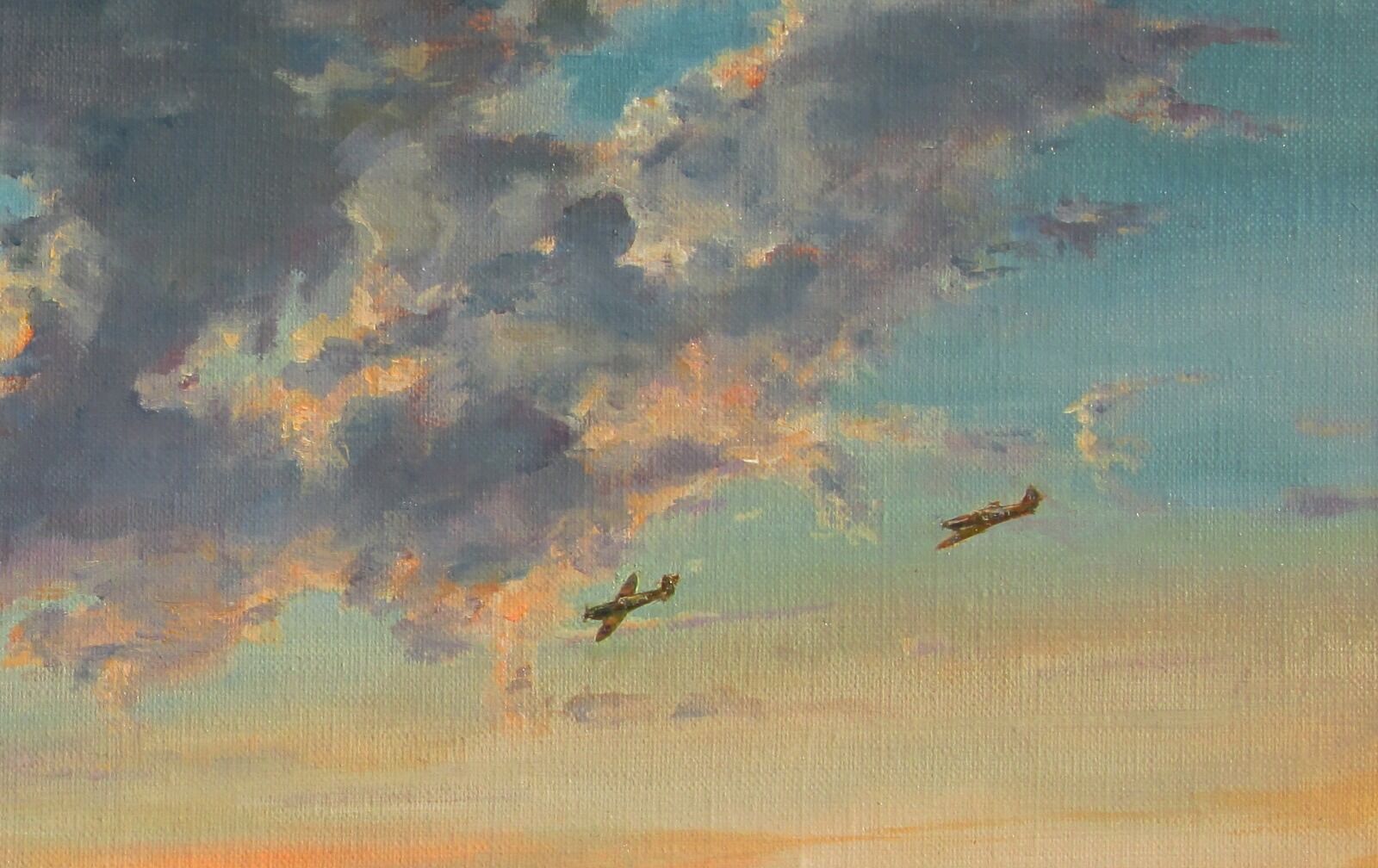
To set the scene for the painting of Jack ‘Famer’ Lawson that finally evolved (and with a little help from a detail belonging to another painting of mine), I’d love to turn your mind to a simultaneous moment occurring on the airfield adjacent to the fields where the painting is set….
It is the 9th September 1940, at approximately 6.40 in the evening at Fowlmere airfield, just a little south of Cambridge.
Groundcrews of 19 Squadron are watching the clock carefully, but not for thought of ‘knocking off. Rather, it’s the knowledge that ‘their’ aircraft have not yet returned… even the freshest face amongst them knows the fuel gauges in those cockpits will be reading pretty near the ‘Empty’ mark by now.
No-one there says a thing about it, but they all know that there’s another all-too-plausible reason why these aircraft aren’t back yet; but one their minds won’t countenance until every other possibility is exhausted.
So while the clock ticks at dispersal, thoughts wander over all the other ‘okay’ reasons for the absence of the two Spitfires: Maybe they’ve landed at another airfield, short on juice; or put down safe in a field, not too far away with a glycol leak; perhaps bailed out safe over London….. anything will do, except the possibility that those two faces just won’t be coming back.
And all the while the clock ticks by nearer to the certainty that they just can’t still be aloft…
Then, as if on the periphery of the conscious perception, like it was willed there by the collective silent hope, the distant rumble of two Merlin engines is suddenly just audible to these ears so attuned to the sound.
Moments later as the sound has grown more distinct and real, and with what seems like a greeting, a little flash of the low sunlight reflects off the wings of the two graceful Spitfires as they sweep into the downwind circuit and turn into their final approach. The release of tension amongst the waiting crews is wholly palpable in the happy stir of activity as they move off to ready to guide their respective aircraft to a standstill after landing.
But it is to the western end of the aerodrome our thoughts must now fly, where other eyes watch this strangely beautiful aerial dance played out…
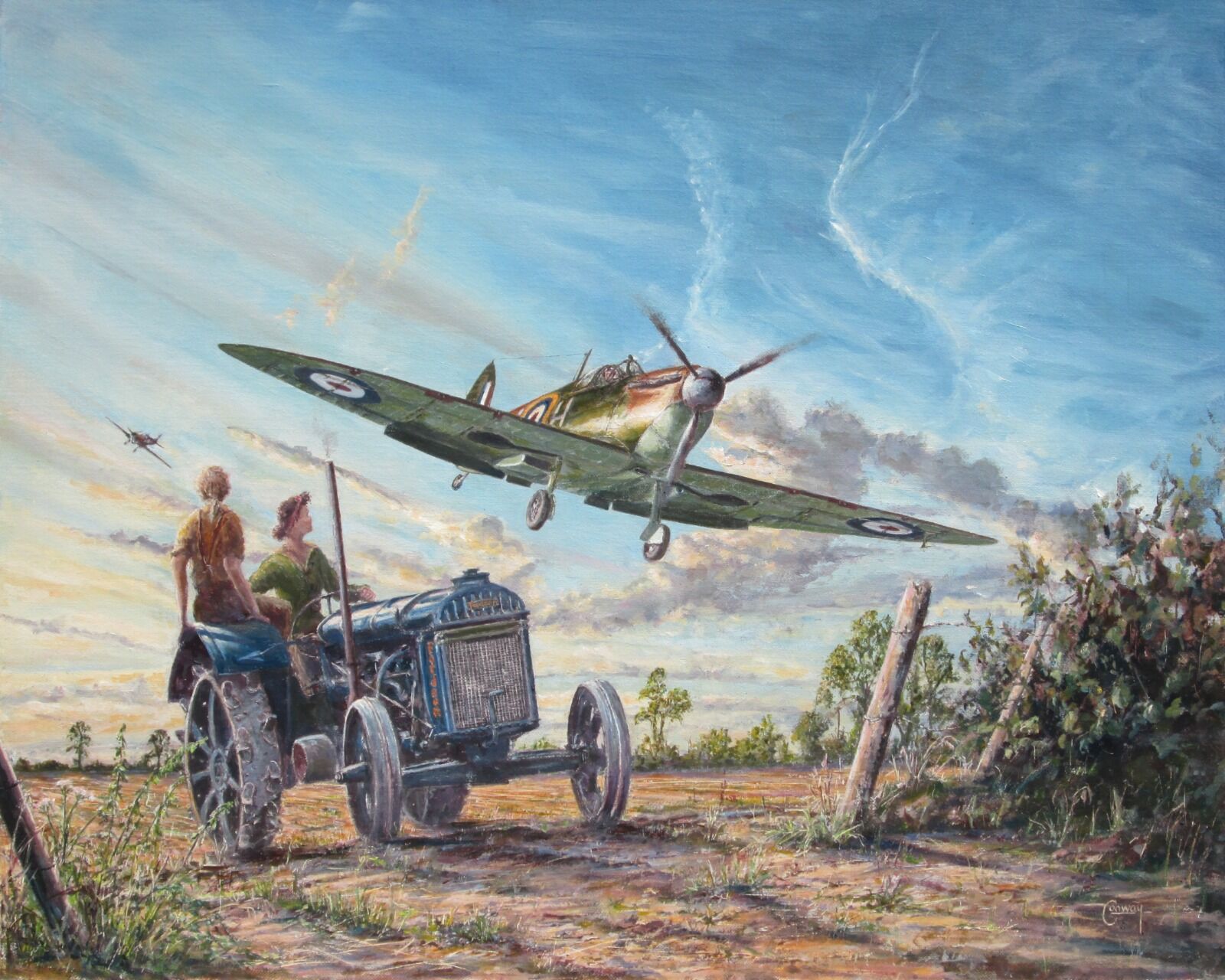
So here the painting is, the result of one quiet little human encounter with a picture of a man eating an apple.
We rejoin the aerial dance of the two 19 Squadron Spitfires on their final approach to landing, just outside the western boundary of Fowlmere Airfield on the 9th Sept 1940 at 6.40 pm.
Just nearby, the two young ‘Land Girls’ of the Women’s Land Army had not long unhitched the plough from the Fordson tractor, relieved at the change from its constant steady engine note and the continuous ‘aura’ of Kerosene that had been their company for the whole long day.
Joints aching from the unceasing vibration of the tractor and minds tired from the relentless concentration of their respective tasks, they had started the short drive back past the aerodrome hedge to the farm.
It’s the newer girl, half perched, half wedged, on the tractor mudguard that spotted the aircraft first.
After all, that’s her job there. Her more experienced companion guides the steel horse up and down the field, her eyes fixed on a point in the hedge, to achieve those long and so strangely necessary straight furrows. Her own task, however, is to keep her vision wholly scanning the vast firmament above, watching for the first sign of danger to them both from the potentially deadly wartime skies.
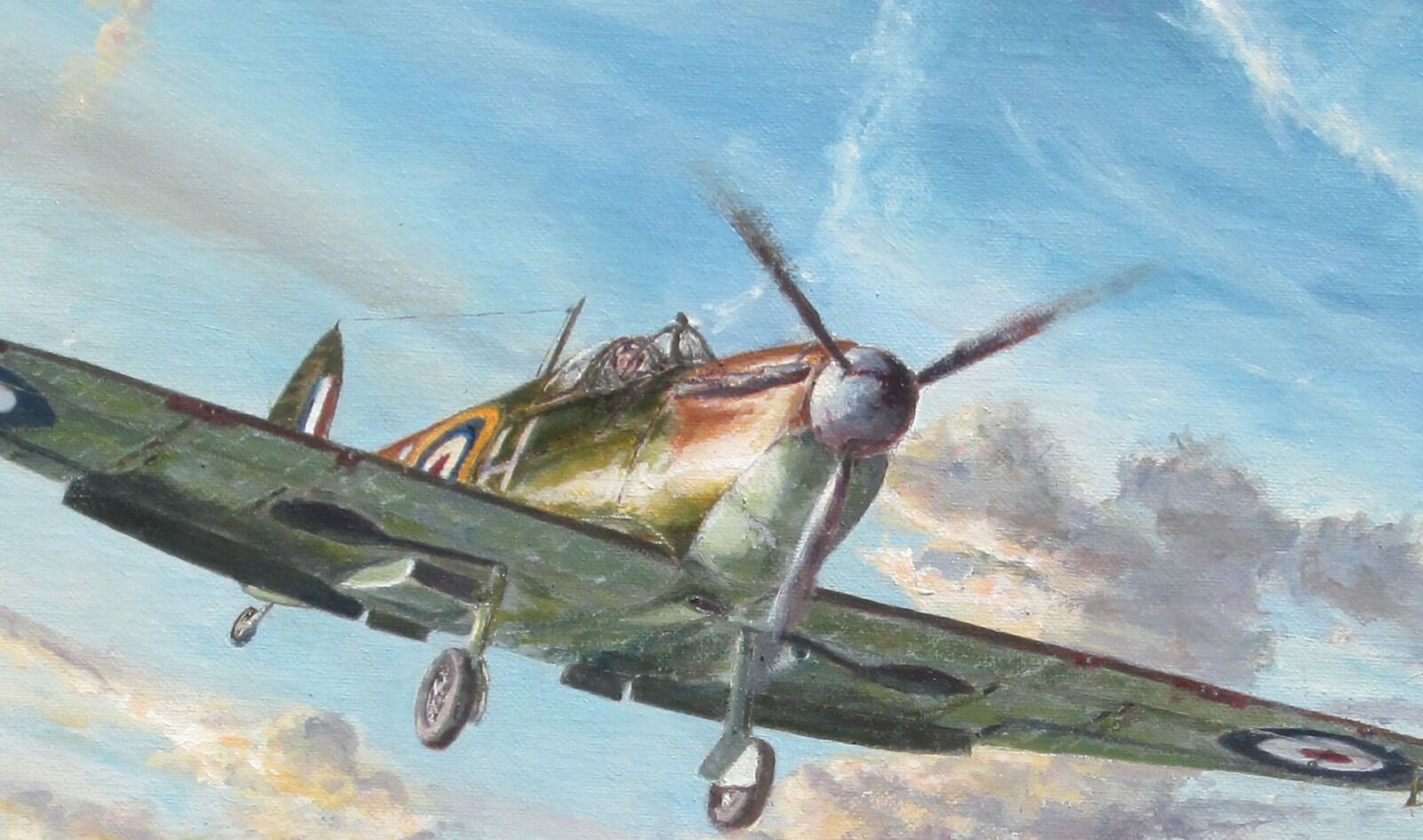
With now weeks of experience of this, she sighted them long before she heard them over the tractor’s noisy engine beat; the same ‘sixth sense’ for their presence also telling her almost immediately after that these were friendly wings. A firm prod to her colleague, and they pull to a stop to watch, as the ticking over Fordson engine becomes entirely drowned by that unmistakable Merlin growl very low and close, the briefest glimpse of a warm and calm smile in their direction from the pilot is just discernible too…
The apparent tranquillity of the scene and the calmness of his smile rather belies the experiences of the pilot since taking off from here an hour and forty minutes earlier.
Walter John Lawson, aka ‘Jack’ ‘Farmer’ Lawson, has been leading a section of his Squadron, alongside two other RAF Squadrons on patrol. Vectored to intercept an enemy formation, they find themselves engaging 130 enemy aircraft over the other side of London. For Jack, it involves a close encounter with that fearsomely armed Luftwaffe fighter, the Me110, and in the ensuing dogfight Jack is the one that has lived to fight another day… for now.
One can’t help but think then, of the welter of emotions that would have been running through his mind as he turned into this landing run back over the fields into Fowlmere.
Though this brief moment at the end of this flight might be my own ‘plausible fiction’, it seems so right to remember him this way.
Jack ‘Farmer’ Lawson, the ‘would-be farmer’ Spitfire pilot, perhaps pushing his landing run just a little lower than necessary, in greeting to the lasses below; lasses who were living out the connection to the land that he craved but had postponed to duty, unknowingly indefinitely, in order to fight for the future of the land itself.
It is the 9th September 1940, at approximately 6.40 in the evening at Fowlmere airfield, just a little south of Cambridge.
Groundcrews of 19 Squadron are watching the clock carefully, but not for thought of ‘knocking off. Rather, it’s the knowledge that ‘their’ aircraft have not yet returned… even the freshest face amongst them knows the fuel gauges in those cockpits will be reading pretty near the ‘Empty’ mark by now.
No-one there says a thing about it, but they all know that there’s another all-too-plausible reason why these aircraft aren’t back yet; but one their minds won’t countenance until every other possibility is exhausted.
So while the clock ticks at dispersal, thoughts wander over all the other ‘okay’ reasons for the absence of the two Spitfires: Maybe they’ve landed at another airfield, short on juice; or put down safe in a field, not too far away with a glycol leak; perhaps bailed out safe over London….. anything will do, except the possibility that those two faces just won’t be coming back.
And all the while the clock ticks by nearer to the certainty that they just can’t still be aloft…
Then, as if on the periphery of the conscious perception, like it was willed there by the collective silent hope, the distant rumble of two Merlin engines is suddenly just audible to these ears so attuned to the sound.
Moments later as the sound has grown more distinct and real, and with what seems like a greeting, a little flash of the low sunlight reflects off the wings of the two graceful Spitfires as they sweep into the downwind circuit and turn into their final approach. The release of tension amongst the waiting crews is wholly palpable in the happy stir of activity as they move off to ready to guide their respective aircraft to a standstill after landing.
But it is to the western end of the aerodrome our thoughts must now fly, where other eyes watch this strangely beautiful aerial dance played out…
So here the painting is, the result of one quiet little human encounter with a picture of a man eating an apple.
We rejoin the aerial dance of the two 19 Squadron Spitfires on their final approach to landing, just outside the western boundary of Fowlmere Airfield on the 9th Sept 1940 at 6.40 pm.
Just nearby, the two young ‘Land Girls’ of the Women’s Land Army had not long unhitched the plough from the Fordson tractor, relieved at the change from its constant steady engine note and the continuous ‘aura’ of Kerosene that had been their company for the whole long day.
Joints aching from the unceasing vibration of the tractor and minds tired from the relentless concentration of their respective tasks, they had started the short drive back past the aerodrome hedge to the farm.
It’s the newer girl, half perched, half wedged, on the tractor mudguard that spotted the aircraft first.
After all, that’s her job there. Her more experienced companion guides the steel horse up and down the field, her eyes fixed on a point in the hedge, to achieve those long and so strangely necessary straight furrows. Her own task, however, is to keep her vision wholly scanning the vast firmament above, watching for the first sign of danger to them both from the potentially deadly wartime skies.
With now weeks of experience of this, she sighted them long before she heard them over the tractor’s noisy engine beat; the same ‘sixth sense’ for their presence also telling her almost immediately after that these were friendly wings. A firm prod to her colleague, and they pull to a stop to watch, as the ticking over Fordson engine becomes entirely drowned by that unmistakable Merlin growl very low and close, the briefest glimpse of a warm and calm smile in their direction from the pilot is just discernible too…
The apparent tranquillity of the scene and the calmness of his smile rather belies the experiences of the pilot since taking off from here an hour and forty minutes earlier.
Walter John Lawson, aka ‘Jack’ ‘Farmer’ Lawson, has been leading a section of his Squadron, alongside two other RAF Squadrons on patrol. Vectored to intercept an enemy formation, they find themselves engaging 130 enemy aircraft over the other side of London. For Jack, it involves a close encounter with that fearsomely armed Luftwaffe fighter, the Me110, and in the ensuing dogfight Jack is the one that has lived to fight another day… for now.
One can’t help but think then, of the welter of emotions that would have been running through his mind as he turned into this landing run back over the fields into Fowlmere.
Though this brief moment at the end of this flight might be my own ‘plausible fiction’, it seems so right to remember him this way.
Jack ‘Farmer’ Lawson, the ‘would-be farmer’ Spitfire pilot, perhaps pushing his landing run just a little lower than necessary, in greeting to the lasses below; lasses who were living out the connection to the land that he craved but had postponed to duty, unknowingly indefinitely, in order to fight for the future of the land itself.