
Jack 'Farmer' Lawson Part 1
The story behind my painting of F/Lt W.J. Lawson (aka Jack 'Farmer' Lawson) Part 1 of 2
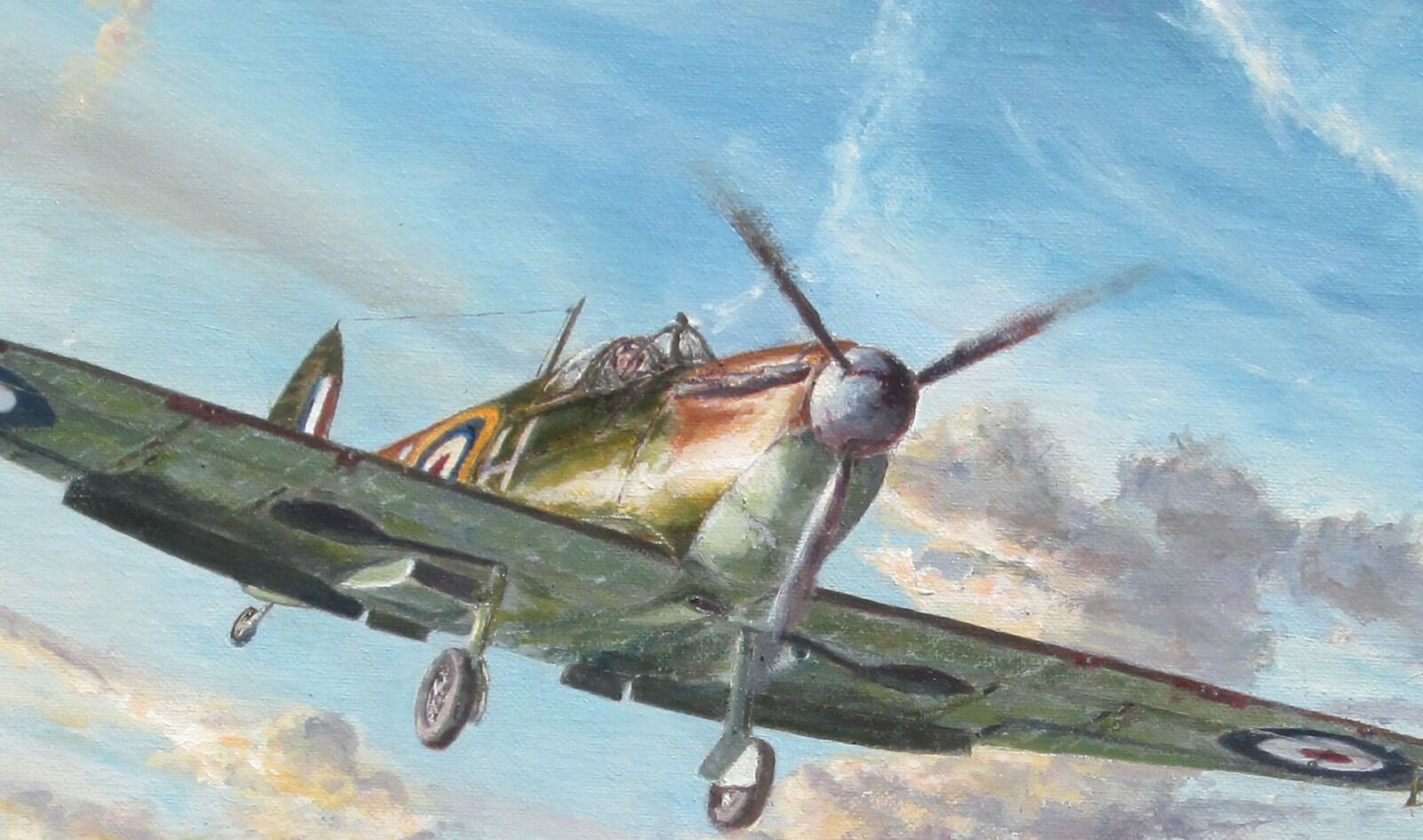
In these new times of AI, where facts are easy to come by and ‘art’ can be so easily generated by a machine, one sometimes has to wonder what the place of a historical aviation artist is.
Yet when I think about how my latest Battle of Britain painting has come together, it becomes abundantly clear to me that the elements that went to make this painting still seem to me to require a complexity of appreciation and subject empathy that remains uniquely human, and I’m glad for that.
Two disparate strands of thought suddenly made a connection here, like the arcing of an electrical current between high voltage wires. In that moment is something that expresses a connection to the subjects of the piece that somehow bypasses the gulf of years in between us and them.
Let me rewind a little to explain. Many of you will be familiar with one of the most iconic pilot pictures of the Battle of Britain, that of Brian ‘Sandy’ Lane of 19 Squadron staring straight at the photographer after a sortie. What less will have noticed is that on the edge of that picture, facing away from the camera, was another pilot, Walter John Lawson, largely known as ‘Jack’.
He is in a number of pictures, taken on the same day by an RAF photographer at Fowlmere. The one I like most of him is an off guard photo of him eating an apple between sorties. The simple humanity of the picture had a direct appeal to me. After all, sometimes it’s easy to forget that these seemingly superhuman guys sometimes just needed a snack too.
I saw that picture of Jack before I knew who he was, but a little research soon led me to another picture of him from the same set of photos on the IWM website, with a very short bio of him, entitled:
‘Flight Lieutenant Jack ‘Farmer’ Lawson’
It included the simple line:
“Lawson talked of becoming a farmer after the war, hence his nickname, but was shot down and killed on 28 August 1941…”
It was a deeply moving sentence, and somehow I immediately felt a kinship with this man and a strong sense of loss at how he had never been able to fulfil this dream.
I thought about how much he must have talked of his aspirations to his colleagues to earn that nickname. Perhaps he had been found at moments by them leaning over the airfield gate, not watching Spitfires landing, but instead fascinated by the operations of the new combine harvesters in the fields adjacent.
Maybe he was to be found musing over the livestock auction results in the local paper when most others could only think of the events recently unfolded on the French coast at Dunkirk. Or was there just the odd wistful comment about some quiet little farmhouse somewhere near Taunton, where he was born, that ‘had his name on it’- it’s not hard to think on him dreaming of how it would all look there, in hopefully better times to come, with fine cattle and a tractor in the yard… whilst he dozed in a chair waiting for the ‘Scramble!’ call.
The notion of that dream was vastly relatable to me. The sheer humanity of this apple eating, agriculturally aspirational, Spitfire pilot was perhaps, to use my earlier metaphor, the high voltage charge, waiting for a way to dissipate its energy flowing into an artistic idea: To commemorate his fallen hopes, dashed somewhere by his loss off the Dutch coast only a year later seemed a kind of inevitability by now.
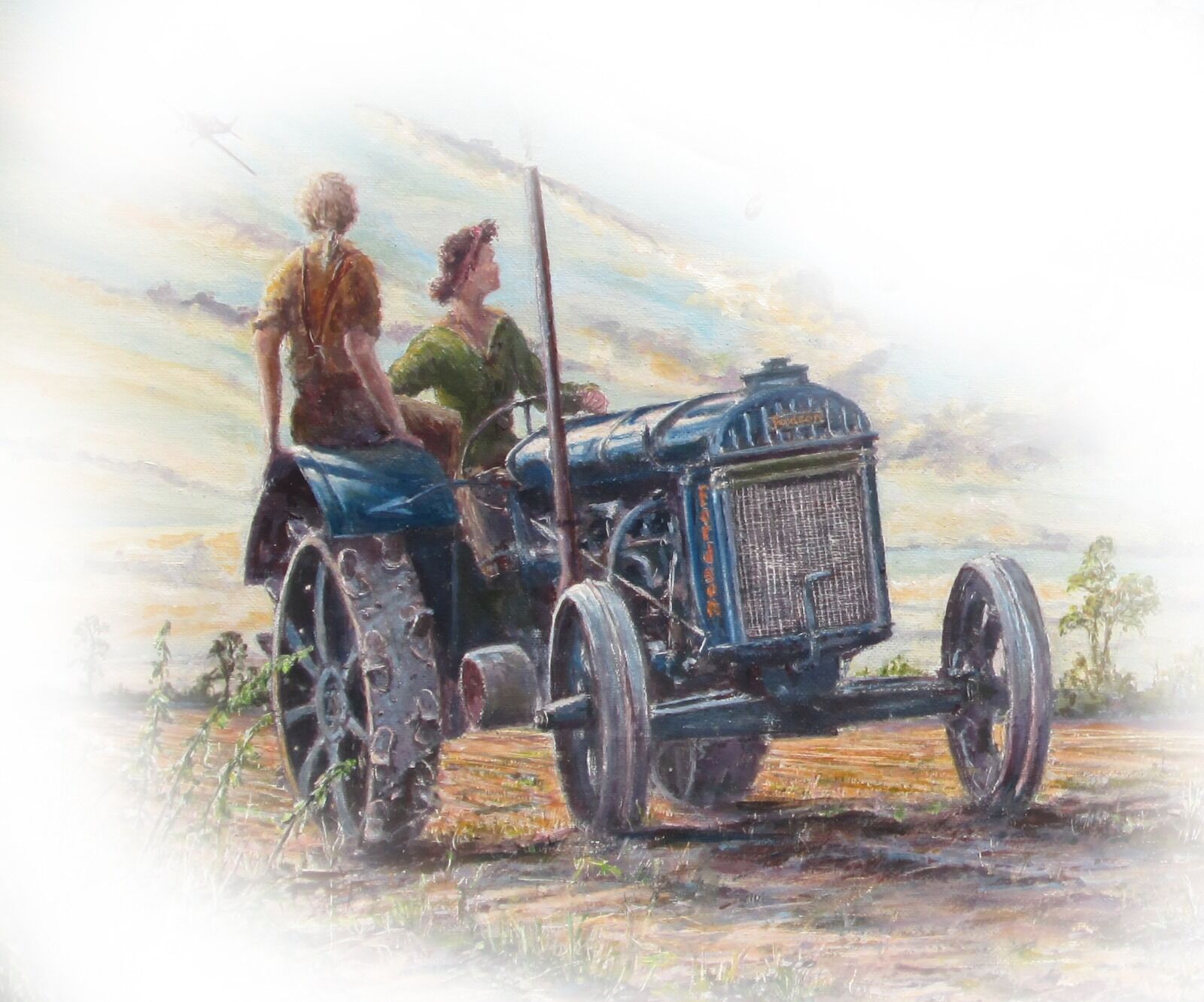
If there was an electric tension in the air for me about the idea for my most recent painting, it didn’t take long for it to ‘find its earth’.
There I was with the idea humming in the mind, posing the question to me, of how to depict Jack ‘Farmer’ Lawson, the 19 Squadron pilot who had earned his ‘farmer’ moniker from having shared with his colleagues his dreams of farming after the war.
It could only have been a day or so later that the spark flew. In that intensely human way our brains make their connections when unresolved ideas are left in the corners of the mind, as if a jump lead had been suddenly thrown across from one side of the mind to the other, there was suddenly a meaningful connection where there had been none.
The anchor for that connection was another painting idea, which a delightful friend had sowed the seed for quite some time ago.
We had been in discussion on the back of one of her lovely photos, talking of tractors and Land Girls, and she had told me how during the war in areas under heavy aerial combat activity, it was often standard practice for Land Girls working tractors in the field to ride the tractor in pairs. One would operate the tractor, the job of the other was that of a ‘sky watcher’, eyes constantly checking the sky for aircraft nearby and having to make a quick decision about whether they were ‘ours’ or ‘theirs’. If the latter, a quick exit from the tractor would be made and cover taken in the nearest ditch.
It was a view of wartime farming experience I hadn’t heard before, and brought to life the realities of the hazards even the farmworkers in the skies under the Battle of Britain faced. When we’d talked about it, I felt that it was something that I’d love to include in a painting at some point, but couldn’t quite think how, so left it relegated to the back of my mind.
Then suddenly here it was, the connection that made both ideas ‘work: Jack the pilot and ‘would be’ farmer and two, actually farming, Land Girls, for whom each aircraft above potentially represented fear for life, or hope for the future, the difference perhaps turning on as little as the sound of an engine note. If many of us love the sound of the Merlin engine, how much more must it have meant to the women on those tractors out in the fields?
The idea was there. There was lots more work to do for sure: Being me, I wanted a real place and time where this moment might have been a plausible footnote to history, had only its authors been more attentive to such details, so it would mean a load of research to get going on, and figuring out a composition is always another journey in itself too; but the stage was firmly set…
Read Part 2...
Yet when I think about how my latest Battle of Britain painting has come together, it becomes abundantly clear to me that the elements that went to make this painting still seem to me to require a complexity of appreciation and subject empathy that remains uniquely human, and I’m glad for that.
Two disparate strands of thought suddenly made a connection here, like the arcing of an electrical current between high voltage wires. In that moment is something that expresses a connection to the subjects of the piece that somehow bypasses the gulf of years in between us and them.
Let me rewind a little to explain. Many of you will be familiar with one of the most iconic pilot pictures of the Battle of Britain, that of Brian ‘Sandy’ Lane of 19 Squadron staring straight at the photographer after a sortie. What less will have noticed is that on the edge of that picture, facing away from the camera, was another pilot, Walter John Lawson, largely known as ‘Jack’.
He is in a number of pictures, taken on the same day by an RAF photographer at Fowlmere. The one I like most of him is an off guard photo of him eating an apple between sorties. The simple humanity of the picture had a direct appeal to me. After all, sometimes it’s easy to forget that these seemingly superhuman guys sometimes just needed a snack too.
I saw that picture of Jack before I knew who he was, but a little research soon led me to another picture of him from the same set of photos on the IWM website, with a very short bio of him, entitled:
‘Flight Lieutenant Jack ‘Farmer’ Lawson’
It included the simple line:
“Lawson talked of becoming a farmer after the war, hence his nickname, but was shot down and killed on 28 August 1941…”
It was a deeply moving sentence, and somehow I immediately felt a kinship with this man and a strong sense of loss at how he had never been able to fulfil this dream.
I thought about how much he must have talked of his aspirations to his colleagues to earn that nickname. Perhaps he had been found at moments by them leaning over the airfield gate, not watching Spitfires landing, but instead fascinated by the operations of the new combine harvesters in the fields adjacent.
Maybe he was to be found musing over the livestock auction results in the local paper when most others could only think of the events recently unfolded on the French coast at Dunkirk. Or was there just the odd wistful comment about some quiet little farmhouse somewhere near Taunton, where he was born, that ‘had his name on it’- it’s not hard to think on him dreaming of how it would all look there, in hopefully better times to come, with fine cattle and a tractor in the yard… whilst he dozed in a chair waiting for the ‘Scramble!’ call.
The notion of that dream was vastly relatable to me. The sheer humanity of this apple eating, agriculturally aspirational, Spitfire pilot was perhaps, to use my earlier metaphor, the high voltage charge, waiting for a way to dissipate its energy flowing into an artistic idea: To commemorate his fallen hopes, dashed somewhere by his loss off the Dutch coast only a year later seemed a kind of inevitability by now.
If there was an electric tension in the air for me about the idea for my most recent painting, it didn’t take long for it to ‘find its earth’.
There I was with the idea humming in the mind, posing the question to me, of how to depict Jack ‘Farmer’ Lawson, the 19 Squadron pilot who had earned his ‘farmer’ moniker from having shared with his colleagues his dreams of farming after the war.
It could only have been a day or so later that the spark flew. In that intensely human way our brains make their connections when unresolved ideas are left in the corners of the mind, as if a jump lead had been suddenly thrown across from one side of the mind to the other, there was suddenly a meaningful connection where there had been none.
The anchor for that connection was another painting idea, which a delightful friend had sowed the seed for quite some time ago.
We had been in discussion on the back of one of her lovely photos, talking of tractors and Land Girls, and she had told me how during the war in areas under heavy aerial combat activity, it was often standard practice for Land Girls working tractors in the field to ride the tractor in pairs. One would operate the tractor, the job of the other was that of a ‘sky watcher’, eyes constantly checking the sky for aircraft nearby and having to make a quick decision about whether they were ‘ours’ or ‘theirs’. If the latter, a quick exit from the tractor would be made and cover taken in the nearest ditch.
It was a view of wartime farming experience I hadn’t heard before, and brought to life the realities of the hazards even the farmworkers in the skies under the Battle of Britain faced. When we’d talked about it, I felt that it was something that I’d love to include in a painting at some point, but couldn’t quite think how, so left it relegated to the back of my mind.
Then suddenly here it was, the connection that made both ideas ‘work: Jack the pilot and ‘would be’ farmer and two, actually farming, Land Girls, for whom each aircraft above potentially represented fear for life, or hope for the future, the difference perhaps turning on as little as the sound of an engine note. If many of us love the sound of the Merlin engine, how much more must it have meant to the women on those tractors out in the fields?
The idea was there. There was lots more work to do for sure: Being me, I wanted a real place and time where this moment might have been a plausible footnote to history, had only its authors been more attentive to such details, so it would mean a load of research to get going on, and figuring out a composition is always another journey in itself too; but the stage was firmly set…
Read Part 2...